
Update from the garden 18 September 2026
Driving into the village of Elford on a Thursday morning, I am often reminded of how very lucky we are to live in such a wonderful, tranquil area of the world. Lawns are once again looking green and vibrant, birds chirp away happily and the river flows by easily, it is the very place to spend a relaxing morning out in the garden.
Our garden does not just take care of itself however, and on Thursday a good group of volunteers were hard at it, working away at a variety of tasks. Sue C was on the ride on mower, giving the lawns a good cut now that they are thriving once again. Sue does a superb job on the mowers, and her husband Steve could be found strimming around the gardens too.
The twins, Harry and Charlie continued to work on their rustic hurdle fencing, preparing the posts by scraping the bark off the bottom section of the wood so that it can be charred at a later date (as part of the process of Shou Sugi Ban- preserving the wood against rot by charring). It may be the last time we see the twins together at the garden for a while as they are off to University and travelling. We thank them for the years of support and wish them all the very best!

Sue C on the mower

A group of Thursday Elford volunteers enjoy a well earned tea break
Lawrence was busy doing some pruning jobs and general tidying of the borders, whilst Dave and Sue W were on hand as always, keeping us volunteers in-check and providing valuable guidance and support, at the same time as doing their own jobs, such as cleaning, fruit picking and maintenance of various tools. Sue W also kept us volunteers going with her delicious cake and homemade biscuits!
Alan H, our much loved fruit expert and long-time volunteer, continued to care for the vast array of shrubs and trees which he has cared for so diligently over the years. From raspberry canes, red currants, black currants, apple trees and pear trees to plums, damsons and greengages, Allan is knowledgeable and skilled in looking after all of them, and we are very much grateful to have him as part of the family here at Elford.
Allan gave me some jobs to do in the sensory garden this week, and I am pleased to say that I found my days work incredibly rewarding, as is usually the case when coming to volunteer at Elford. Down by the pond and Chinese bridge, a border had become tangled and messy thanks to a number of self seeded plants and the smothering effects of ground elder Aegopodium podagraria.
The first task was to move an Oak sapling which had somehow found its way into the border and had gone relatively unnoticed despite now being a good height of three to four feet. If left to grow on, this sapling would become far too large for this particular spot in the sensory garden, with its close, meandering paths and planting scheme designed to topple out at you and draw you in. This Oak must have germinated from an acorn, probably buried and forgotten by one of our resident squirrels, and somehow had managed to survive its early juvenile years without being weeded out or suffocated by surrounding plants. Although slow growing, the Oak would eventually grow to tall and wide for the border, shading out the plants underneath. It is simply a case of the wrong place for this particular plant, despite the fact that it appeared to be growing away quite happily.

Oak sapling in the sensory garden

Long tap root of the sapling

The Oak in its new home
Being able to transplant an Oak sapling is an incredibly special feeling. The English Oak, Quercus robur, is a majestic tree, both in its appearance with a classical sprawling, twisted canopy of limbs, and its value for wildlife. It is by far my most treasured native tree of any variety. The contribution of oak trees to landscapes, biodiversity, culture and economy is enormous with a single oak able to support 2,300 wildlife species, providing vital spaces to eat, shelter and breed.
Oak flowers are eaten by red and grey squirrels and many insects, including the caterpillars of purple hairstreak butterfly and dark-crimson underwing moth which rely solely on oak. The pollen is also a popular food source for bees, including the oak-mining bee, which feeds almost exclusively on oak pollen. Never noticed Oak flowers before? Male and female flowers grow on the same tree. Male flowers grow in long clusters and appear between April and May. The female flowers look like tiny red flower buds between the leaves and branches.
Oak trees support 31 different mammals, largely down to the acorns they provide. They’re a favourite food of many woodland creatures including badgers, deer, wild boar, squirrel and wood mouse. Acorns are also enjoyed by birds like woodpecker, rook, nuthatch and the jay.
Oaks are a key component of our British ecosystems and it has recently been confirmed that the native English Oak could be a key player in developing climate resilient green spaces. They are one of the few native species which can adapt to both current and future climatic conditions, due to their long tap roots and lobed leaves (as opposed to broad leaved species) making them suitable components for reforestation efforts. However, there is some confusion over how resilient our native oak trees actually are. Ancient oaks (being at least 400 years old) are recorded to be struggling to cope with the repeated droughts which we are experiencing in the UK. Across the country experts are noticing how our ancient oaks are shedding limbs and losing leaves far earlier in the season than we are used to seeing, in order to try and prevent water loss through evaporation. Despite this, Oak trees can and should play a significant role in our landscape in the future and I was pleased to play a very small part in ensuring we have oaks at Elford for many years to come.

A weed free Hypericum

A good example of how ground elder roots can cause a nuisance

A Hypericum being suffocated by ground elder
My next job for the day involved trying to free some of the shrubs and herbaceous perennials in the sensory garden from being suffocated by ground elder. Unfortunately we have a few patches of ground elder across the garden here at Elford and it has become somewhat of a nemesis over the years for me personally. In fact, I believe I have bored you on a previous occasion with the history of ground elder on our isles, in an article which can be found here.
After a few hours of digging and carefully untangling the ground elder from the roots of various shrubs and also an array of wild garlic bulb roots (which could not be confused for anything else due to the incredibly strong garlic smell they were emitting), I had managed to make a small dent in the wash of green ground elder leaves which had been carpeting the floor of the particular bed I was working on.
As I worked I was kept company by a proud and vocal robin red breast, whose chirping and calling proved an extremely relaxing soundtrack to my afternoon.

This piece was written by Ashley Jones, garden volunteer. If you would like to volunteer at the garden, please get in contact, you would be most welcome!
Update from the garden 05 September 2026
One of the things which I especially enjoy about volunteering at Elford Hall Gardens is the amount of time I get to spend outdoors surrounded by nature (and friends!) Something which I have taken to notice with greater frequently is how much more aware of the changing seasons I have become thanks to my time at the gardens. We are now approaching autumn and the nights are drawing in, when I awake at 5.am. on a workday, it is still dark outside and there is a cool dew in the air. It feels refreshing in contrast to the long, dry summer we have just experienced and I can almost feel fresh life being carried in on the wind, and dispersing into the gardens outside. We've had a reasonable amount of rainfall over the past few weeks, which means the grass is beginning to green up (Steve & Sue C will be out there mowing in no time!) and plants are no longer wilting quite so readily. This time of year also means an abundance of crops are ready to harvest and at Elford the volunteers have been very busy selecting the best of fresh fruits and vegetables for visitors to acquire for a donation. Lawrence for example, could be found up a ladder, with Allan H's 100 year-old basket (a family heirloom passed through the generations) in hand collecting Damsons, on the outer edge of the Rose Garden.
Allan H and Sue W have been busy turning the produce into delicious preserves, which can also be purchased from the produce table along with Apples of all varieties, as they become ready to harvest. Please do come down and take a look. It is all grown here at the garden and is as fresh as you will get! I myself purchased some Damsons which were placed into a jar over the weekend, submerged in gin, to hopefully make a fruity gin which I plan to gift to relatives at Christmas!


In fact, whilst I was picking a range of apples on Thursday, I came to thinking as to why so much produce gets wasted in the UK on an annual basis. I held an apple in my hand, and looked at its asymmetrical, natural form, with slightly misshapen curves. Such an apple would likely be discarded by many in our modern day world where perfection and uniformity is sought above all else. But, need this be the case? I asked myself. There were plenty of windfall cooking apples to be collected too, some of which had slight bruises, or the effects of the codling moth visible. Again, such fruit would likely be overlooked. However all of these fruits can be used perfectly, without risk of causing illness! Simply cutting out the bad parts and eating the rest, whilst requiring a tiny amount of additional effort, results in far less wastage! So please do come and visit the produce table on your next visit. Some of our fruits might not look like what you expect to see in a supermarket, but it is still fruit which is perfectly safe to eat. In fact, it is all fresh, organically grown fruit, free from pesticides and whatever else supermarkets spray on their produce to keep it fresh for weeks on end. Your donations will also be supporting a really special local green space!


In the sensory garden meanwhile, much of the planting has already begun to die back in an attempt to overwinter and recover from the harsh summer drought. However, the grape vine is still on full show and I also noticed some hops growing up and through the vine. Hops, Humulus lupulus, are a gorgeous plant to look at in late summer, with their luscious, pale green, cone-shaped fruits. Whilst Hop has had a number of uses for us humans for hundreds of years, largely in beer making (their bacteriostatic properties are key), the plant also has a superb value for wildlife as it can be used to create a dense habitat when grown amongst hedgerow plants such as Hawthorn and therefore provides valuable refuge for birds and insects alike.
In the woods next to the river, I also came across the first of the autumn cyclamen Cyclamen hederifolium. The small, pink flowers shoot up from the ground before ivy leaves follow on in late autumn. It just goes to show that there is always plenty of beauty to find in the garden, no matter the time of year!
This piece was written by Ashley Jones, garden volunteer. If you would like to volunteer at the garden, please get in contact, you would be most welcome!


Elford Hall Walled Garden Project at 20!
Interested in learning more about how we started as a charitable project? Watch this space! We will be sharing a newsletter which features the origin of our story soon! In the meantime, why not have a look at this YouTube video where one of the founding members of the project, Dick Cowley, shares a little more about the history of the garden
Update from the garden 22 August 2026
It feels like a long time coming, but as we end August we have finally welcomed some much needed rain! As I was picking up the windfall cooking apples in the orchard on Thursday morning I heard a rumble and soon dark clouds moved in overhead. Within minutes we had a heavy burst of rain and it was glorious! I think I could have danced with delight at the sight of puddles forming on the edge of the paths. Whilst we have had a few good showers now, we will need an awful lot more rain in the coming weeks in order for the flora in the gardens and our wider landscape, to recover.
Image shows rainfall collecting outside the tool bothy. Hurray!


The past month or so has been none stop for our volunteers. As visitors will have noticed, our plants have been significantly impacted by this year's drought. In actual fact, it wasn't just the most recent three months of drought which has had an impact, but also the build up of repeated dry summers. You may recall that just last year we had virtually no rainfall between early Spring and late Summer. These repeated weather extremities place enormous strain on our plants and wildlife. Annual flowers have rushed through their lifecycle with haste, meaning they flowered and set seed quicker than you can say "fetch me that watering can please!" Perennials have also really suffered, meaning our borders can at times appear a wash of brown, crisp materials. We've been cutting back dead and decaying material where we can, and have stripped apples from a few trees in the orchard which were looking especially sad, in order to try and help them conserve water and energy, in the hope that they will survive. A lot of the trees in the orchard have shed their fruit themselves in an attempt to do this naturally. Volunteer Lawrence has been pruning the almond trees that line the path heading towards the Head Gardener's Cottage, whilst Sue and Steve have been busy strimming in the car park, orchard and Sensory Garden. We are also preparing for our next big project, painting the Boat House with scaffolding now in place.


Allan and his son have been doing a truly wonderful job on the volunteer allotment plot, as can be seen with the large pumpkins on display! They have been caring for the plot for some time now with great enthusiasm, care and attention and produce they grow is gratefully received by volunteers, with excess being available on the produce table for a donation.
We have been asked by a number of visitors as to whether we water the garden and if not why not? We try to manage water on site with care and an awareness of the changing climate. This means we water responsibly when and where possible. Visitors will notice the large number of water butts we have on site, collecting rainwater as it runs off the bothy and various tool shed roofs. We also have water butts around the allotment plots for our allotment holders to use. We do have running water on-site but at various points around the garden water pressure is a problem. The garden is also run entirely by volunteers as a charity, with many of these fabulous people being of a wiser, more experienced stage of life. We don't feel it is fair to ask some of these volunteers, who kindly give their spare time to the gardens, to haul heavy watering cans around the site. To answer the question of whether we have noticed the plants could use a drink, yes, we absolutely have! However, as mentioned above, there are a number of factors that prevent us from watering the entire site on a regular basis. That is all before we even consider the fact that vast parts of the country are officially in drought and whether it would be fair to use water on our gardens when so many others have hosepipe bans and so many farmers are struggling. We have been asked why we are not using water from the river, which runs adjacent to the gardens. Again, there are a number of factors, including whether we would need a license to extract water from the river, how we would do so, how we would store the water and then how we cold transport the water around the gardens. Of course if any visitors believe they can help us with these problems, we are eager to welcome more volunteers of all ages and would love to hear more from you!
We will also be thinking about what additional steps we can take, to help care for our garden in the future. Hopefully it is now beyond all doubt in most people's minds that climate change is real and is here now. What does this mean for us? It means more frequent weather extremes. In summer we will see droughts like the one we are (still) experiencing more and more frequently, whilst in winter we will see an increase in wetter, windier weather. Unless we think about how we garden more carefully, we will continue to see our borders struggling and looking rather sad and disappointing, let alone failing to provide enjoyment and sustenance for our visitors and wildlife, which of course is the ultimate goal for us here at Elford Hall Garden.
There will be a number of matters to consider in order to help make the garden more climate resilient. For example, we will consider how we can improve our soil across the site. Soil is perhaps the key element to establishing a healthy, adaptable environment which will allow our plants to thrive, whatever the weather. A healthy soil should have levels of organic matter sitting at around 5%. This helps give soil a good crumble structure, which provides good drainage in wet weather, yet contains enough organic materials to hold onto water and make it available for plant roots to take up when needed. It also helps create air pores so plant roots can respirate aerobically, and is also loose enough for roots to grow deep and wide within the soil. A healthy soil, with the right levels of organic matter, will also allow the fungal network within the soil to thrive. The fungal network, which is sometimes referred to as the "wood wide web" can spread much wider than plant roots and has a symbiotic, mutually beneficial relationship with the plants. The mycorrhizal fungi can help provide water and nutrients to plants that their own root network cannot reach, and in return the plants provide the fungi with vital sugars and other products of photosynthesis. You can see therefore, why we would be eager to improve the health of or own soil, in order to encourage the mycorrhizal fungi to thrive and help our plants to better cope with summer droughts. There is even scientific evidence to suggest that, through this "Wood Wide Web", plants can help support one another, passing nutrients from those with less need to those who are in need, at a certain point in time. (This by the way, is a fascinating area of horticulture and natural science. If, like me, you are keen to learn more about soil science and mycorrhizal fungi, there are several books, websites and tv programmes out there for you to delve into. I would recommend "The Hidden Life of Trees" by Peter Wohlleben and "Finding the Mother Tree" by Suzanne Simard).
Organic matter can most easily be added to the soil by applying a mulch in Spring. It could be garden compost, farmyard manure, mushroom compost or even something such as composted wood chippings, or leaf mould. A good, few inches of organic mulch applied in spring will help the soil retain moisture as we head into drier months. At Elford we will look at whether we can better use our compost bins to provide our own organic mulches, and how we can collect and store fallen leaves to create leaf mould, both of which can be applied in Spring.
Other matters to consider include how we can store rainwater more efficiently and how we can then use that water around the garden in light of our volunteer demographics and physical capabilities. Perhaps we can use more modern methods of watering, like fitting watering rings around our fruit trees which would slowly emit water straight to the roots across a period of days, as opposed to it evaporating when applied to the soil in one go through a watering can. We also need to think about whether we need to alter our planting plan. Do we need to create more layered, compact planting which will help create a canopy of vegetation which will leave less bare soil, create more shade and help reduce water loss through evaporation? Do we need to consider more drought tolerant plants? All such aspects will need to be carefully considered with the inclusion of all our volunteers.
Finally, on a more positive note (and apologies if the above was too much doom and gloom for a summer's day!), we were recently fortunate enough to welcome a new visitor to the gardens who has very kindly featured us on her YouTube channel. Jenny, from @jennyfromtheplot visited us a few weeks ago and spoke to some of our lovely volunteers. She made a fantastic video which I absolutely loved watching, I highly recommend her channel. I have Jenny's permission to share the video below, so please give it a watch! It was truly wonderful to see how much Jenny enjoyed her visit. We volunteers spend many hours at the garden, working away, to create what we hope is a special place for people to visit. In truth, it isn't much of a chore, we love it! I'd honestly spend every day volunteering in the gardens if I could, but it is very much a huge reward when we hear that our visitors appreciate the space as much as we do. So thank you Jenny!
Some final news, please keep an eye out for fresh fruit and veg on the produce table, available for a donation. We will have lots on offer, including a bounty of windfall cooking apples from my morning of collecting on Thursday. I tested one and although the trees shed them a little prematurely, they are still superb for cooking and baking, including in a nice warm apple and blackberry crumble!
This piece was written by Ashley Jones, garden volunteer. If you would like to volunteer at the garden, please get in contact, you would be most welcome!
Update from the garden 30 July 2026
As July comes to a close, we continue to battle with our prolonged period of extremely dry weather. Here at Elford we are no different to the rest of the country, in that we have to adapt to an ever increasing series of weather extremities. Thankfully our team of volunteers are at hand to ensure the garden is looking as spectacular as it possibly can do in the face of such challenging conditions. At the gardens we water responsibly, relying heavily on rainwater captured within water butts positioned around the site. These are a welcome benefit for allotment plot holders.
We are also taking note of which plants are adapting best to the extremes in weather. On my walk around the garden I noticed a few which are in perfect health. Even better, many of these plants are fantastic for our local wildlife too!
First we have the Cardoon Cynara cardunculus. This plant is also known as artichoke thistle, and is actually a very close resemblance to the globe artichoke. The spectacular purple flowers which are very much like a thistle, add drama to the border, as well as vertical interest. Did you know that you can actually eat part of the Cardoon? Unlike Globe artichoke, which is prized for it's flower buds, the edible part of the Cardoon is the stalk. This thick, ribbed structure can be blanched to remove the bitterness, and then added to baked dishes or even fried. When in flower, the Cardoon attracts bees, butterflies and other pollinating insects like hoverflies and beetles. After flowering, the seeds are a valuable food source for birds such as goldfinches and linnets. The soft thistledown is also used by birds for nest lining. A really valuable plant for the garden border therefore.


I also noted a fantastic companion to the Cardoon, in the Teasel Dipsacus fullonum. The common teasel is a tall biennial that has thick taproots, allowing it to stay anchored (which is vital for a tall plant like this) and more importantly draw up vital nutrients from the subsoil. It has brown, prickly stems and conical seed heads. These plants are in flower between July and August, where flower heads are green with rings of purple flowers. They turn brown once the flowers are spent, and the seedheads persist long into the winter, which is fantastic for birds, but also provides much interest on a frosty winter's morning.
Finally we have Buddleja davidii and common fennel Foeniculum vulgare. I spotted these two plants growing together against a south-facing wall in the gardens here at Elford. Both were thriving despite the dry conditions. It shouldn't be a surprise to see this. Buddleia was introduced to the UK from Asia and can thrive in some of the driest conditions the UK can throw at it, as I note every day on the train into Birmingham, where armies of these butterfly bushes can be seen growing from the smallest cracks in rubble and on stony railside spaces.
Again, this is a superb plant for attracting pollinators, although it is sometimes viewed as being unsightly when the flowers are spent and turn brown. This need not be the case as Buddleia can be deadheaded, cutting back to the next pair of leaf buds, to encourage new flower blooms later in the summer/Autumn period.
The common fennel is becoming somewhat fashionable in UK gardens. In spring it provides vibrant, luscious thronged foliage which provides great value for money (as it is a plant which will spread everywhere). Then, as the seasons change and summer comes along, tall flower stems are thrown up, on which golden-yellow umbels bloom, attracting a wide range of pollinators. In Spring the foliage is very aromatic and gives a sense of the Mediterranean. Every part of the plant is edible, with seeds used in curries and fronds used as a herb for seasoning.


I was also pleased to see plenty of colour in the sensory garden, with Hydrangeas in flower, Echinops rito thistles dancing in the wind, and the yellow blooms of Common Tansy Tanacetum vulgare.
Our orchard is thankfully a well established one, which means that it is still fruiting well, despite the exceptional weather, although we must be wary of the potential long-term impact of such dry weather on our trees. Visitors may wonder why they come across apples on the floor. These are windfall apples. It is natural for apple trees to lose the odd fruit at this time of year, as the trees naturally thin out a few of their fruits. However the dry weather does appear to be causing the trees to react a little more than usual. Despite what appearances suggest, the fruit is not yet ready for picking. Here in the UK we will typically not harvest the apples until the autumn, when the apples are full of flavour. We ask that visitors refrain from picking fruit from the trees. We are a volunteer run garden and an awful lot of hard work has gone into creating and maintaining the orchard. Please wait until fruit is picked by the volunteers and made available from the produce table.
Speaking of which, the first plum trees have been inspected by Dave, who picked enough to fill a good number of punnets, along with greengages. I purchase some myself and can confirm that they are just the ticket for an afternoon snack, perfectly sweet and juicy. Please do come down to the garden and visit the produce table!


This piece was written by Ashley Jones, garden volunteer. If you would like to volunteer at the garden, please get in contact, you would be most welcome!
Update from the garden May 2026
The garden has sprung to life with the recent warm weather, and in this final week of May we have seen some much needed rain too. But there is much more to Elford Hall Garden than the beautiful plants. We are also fortunate enough to be situated on the breath taking River Tame and in the recent heat wave we saw visitors arriving not just by foot and by car, but also by canoe and paddle board.


The Rose Garden has very much come into its own and is now full of colour which our dedicated volunteers are doing their very best to prolong with deadheading and watering. It is certainly well worth a visit if you have time over the coming days.

This piece was written by Ashley Jones, garden volunteer. If you would like to volunteer at the garden, please get in contact, you would be most welcome!
Update from the garden 21st April 2026
This week we have an update from one of our much loved volunteers.
Hi, I'm Phil, 76 years of age, and a retired vehicle body repair college lecturer. Vehicle repair wasn't always my trade, I started my working life as an improver bricklayer for 5 years.
I discovered Elford's hidden secret garden some six years ago and immediately I was struck by the amount of work which had been, and continues to be, carried out here. I did however also note that there is an immense quantity of very old brickwork, much of which needs ongoing TLC and maintenance. I put myself forwards to start on this task. One job that bricklayers do not like is re-pointing, but I find the work at Elford gardens so rewarding, so I make an exception here. Knowing it helps with extending the access and continued pleasurable use of this splendid site for all is so important to me.
The perimeter wall was built using lime mortar and any re-pointing also has to be completed with lime mortar as this allows the brickwork to expand and contract without cracking. Working with lime mortars is a rare thing these days and a pleasure, but it does have its downsides, mainly being that it cannot be used when frost is to be expected, so this limits my work to milder months of the year.
Some may think of this kind of work as boring, but I find it to be relaxing. There are no timescales to meet, and any work carried out is always appreciated by our project leader Dave. The volunteers are such a friendly group, and make all feel very welcome. Sue's cake served at tea breaks (thanks Sue) are a great social event and a chance to share stories, ideas or even pick Alan's brain for some gardening tips. There is a wealth of knowledge to tap into amongst the volunteers. Volunteering at Elford is so rewarding and immense fun, I highly reccomend it and there is always something to get stuck into. If you ancy getting involved please do get in touch!

Update from the garden 11th April 2026
The weather these past few weeks has been changeable to say the least. April showers indeed! From a Bank Holiday weekend which almost felt like summer, to low single digits and rain, as we close out this second week of the month, we certainly have seen a wide range of the best the weather has to throw at us! One thing is for certain though, longer days and (generally) warmer nights mean that the garden is beginning to shape up nicely, in fact there are so many plants beginning to show their best, it is really hard to know where to look. Spring is a time when there is so much to do in the garden, we are forever busy and have a never ending list of jobs to be getting on with. However, I am certainly no Monty Don or Francis Tophill, and won't therefore be sharing a list of jobs to do in the garden this week. Instead, I thought I'd share some pictures I took whilst doing some jobs around the site, on this windy Spring Saturday, so you too can see just how much there is to see in the gardens at this time of year.
Beginning in the long border, which is found on the outer Eastern wall of the garden, opposite the Head Gardener's cottage. Many a long border in historic gardens around the country will be herbaceous borders, but here at Elford we have what would probably be better referred to as a mixed border. It is home to a wide range of trees, shrubs, understory herbaceous perennials, ground cover evergreens and bulbs. At the present moment in time there is a superb, very large Crab Apple tree in blossom, which gives the effect of clouds of whites and pinks in abundance, sitting above an understory Wayfaring tree (Viburnum lantana) and a Japanese meadowsweet bush (Spiraea japonica), with many a Cranesbill (possibly Geranium endressii) as groundcover.


Further along the border I came across a really lovely looking Pieris, which has been planted in combination with a Mexican Orange blossom (Choisya ternata) and again there is an abundance of hardy geraniums in the foreground providing helpful groundcover. I found the contrasting colours, greens, yellows and fiery reds, really 'popped' and drew the eye in. At the far end of the border, where the water tower juts out, there was a large old fashioned Weigela (Weigela florida) in bloom, which has deep pink bell-shaped flowers that are very pretty when viewed in the dappled shade of midday.


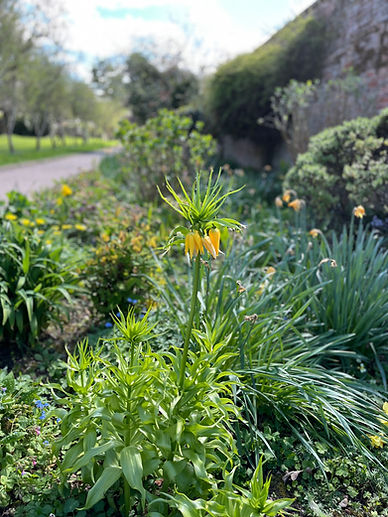
Finally for this part of the garden, amongst the numerous hellebores and daffodils, I came across a lovely Crown imperial 'Lutea' (Fritillaria imperialis 'Lutea'), whose drooping yellow terminal umbels of flowers are topped with thick green leaf-like bracts. There was also a Camellia standard in bloom, with velvet red flowers showing like the deepest red fruits on an apple tree.

Moving on into the woodland area of the gardens next, where we have seen the full array of Spring favourites already this year. In early February we saw Snowdrops aplenty, followed in late March by waves of daffodils. Now there are Bluebells (Hyacinthoides non-scripta with the odd albino white flower too!) to be found in the shade of the large pine trees, with red dead-nettle (Lamium purpureum) mixed in for even more colour.


There are a few other plants coming into flower which offer a glimpse of what is to come, with a majestic Crab Apple in blossom and the first Cow parsley (Anthriscus sylvestris) that I have seen this year, down by the river bank. As we head into May I expect the whole river bank to be awash with the white umbels of Cow parsley, dancing in the wind in the dappled early morning sunlight. The river bank is an incredibly peaceful place to be on a quiet sunny morning, with Robins and Chiffchaff's singing away, I highly recommend it as therapy for the soul!


Next we come to the sensory garden. This space is packed full of colour, shapes, textures, smells and sounds in the height of summer, but right now many of the showpiece plants in this part of the garden are still only just beginning to wake up. That doesn't however mean that this part of the gardens should be ignored at this time of year. As many parts of the space are shaded, we have a wide range of planting schemes in this part of the garden. Next to the pond and Japanese bridge there is a sea of wild garlic (Allium ursinum) which I unfortunately forgot to photograph, as it is not quite yet in flower, but I did see many lovely examples of Garlic mustard (Alliaria petiolata) or Jack-by-the-hedge (what a fabulous name!) This plant may look like a fancy stinging nettle, but it is certainly far more exciting than that! A biennial, completing its lifecycle across two growing seasons, it can grow up to a metre tall. He has heart-shaped leaves with small, neat white flowers. When the leaves are crushed they produce a faint garlic odour, and the plant can be used in salads or as flavouring for fish and meat (the leaves should be harvested young, before flowers bloom). Jack-by-the-hedge prefers a shady spot, such as in the lee of a hedge (as the name suggests)!
I also came across a plant which I had somehow never really noticed before, tucked away under a Windmill palm. With leaves like a gigantic maple leaf, and a rather rude looking young shoot of vibrant red colouring, I was soon informed by a much more knowledgeable fellow volunteer that it was a Chinese rhubarb (Rheum palmatum) I was looking at! This is a purely ornamental plant and should not be eaten.


The sensory garden is also home to a pretty display of colourful Tulips, as well as some healthy looking honeywort (Cerinthe major 'Purpurascens') and numerous patches of forget-me-not (Myosotis sylvatica) and Lungwort (Pulmonaria) the latter of which were incredibly popular with the garden's pollinating insects this morning! The purple flowers are lovely, but I admire lungwort more for their spotted foliage, which I think adds a nice touch of difference.


Finally we have the fruit orchard, and also inside the walled garden. I have no pictures to share of the fruit orchard. The Cherry trees are full of blossom, but the Apples are only just beginning to show. It won't be long however, and there will be row upon row of pinky/red/white clouds of blossom!
Inside the walled garden we obviously have our Rose garden, fruit cages, trained fruit trees, Wisteria, and much much more. Most of those elements are not quite at their best, but I did take a few snaps of some colour that caught my eye as I made my way to the bothy for a tea break! Some smaller Cherry trees are below, full of white blossom, and also pictured is a vigorous looking Rosemary (Salvia rosmarinus), which of course smelt incredible when I gave my fingers a gentle rub through its leaves!


Hopefully I've been able to wet your appetite there, and not bore you with my musings over some of the lovely plants here at Elford Hall Walled Gardens. If so, why not come and visit us? We'd love to welcome you to our gardening haven!
This piece was written by Ashley Jones, garden volunteer. If you would like to volunteer at the garden, please get in contact, you would be most welcome!
Update from the garden 21st March 2026
I thought, as we near the Easter weekend, rather than bore you with more tales of what I have been getting up to in the garden, I'd share some details of what a handful of my fellow volunteers have been busy doing in the gardens here at Elford!
There were a few of us knocking around on Saturday, but I'll begin with my good friends Darryl and Charlie, who were today continuing their long standing task of restoring the hurdle fencing which lines the entrance drive to the gardens. This is a long and time consuming job which is requiring the brute strength of the two brave souls, who are being fuelled along the way by lots of tea and cake, thanks to Sue, our much loved volunteer who really should enter the Great British Bake-off, although on second thoughts don't do that Sue! We would be lost without your cakes!

Next up we have Lynne, another Saturday regular who was busy as always, completing a number of tasks, from cleaning in the Head Gardener's Cottage, to watering the seedlings in the greenhouse.
Also busy working away was Gordon, who was hard at work turning the compost heaps down by the river. Gordon can often be found down by the compost heaps on a Saturday, and is a vital member of the team, helping ensure our decaying plant materials can be put to good use in the garden.


Jon could be found just outside the Head Gardener's Cottage, where he was busy giving the produce table a bit of TLC, here he is posing on his ladder, shorts and all.
Next to Jon we have Allan, our key man when it comes to looking after our soft and top fruit plants. Today Allan was busy preparing the mound (found in the North end of the sensory garden) for planting with perennials as we move into April.


I was also lucky enough to catch Loz hard at work as he was installing a camera in one of the bird boxes on the inner walls o the walled garden, adjacent to the Bothy. At the present time no birds are nesting in the box (Loz had been watching it for a while to make sure he wouldn't be disturbing anything) but with our camera now installed, we hope to welcome some visitors soon!


Last, but certainly not least, I decided to go and annoy Alan, who alongside his son, takes superb care of the volunteer allotment space. Today I found him busy planting beetroot seedlings. Alan has done a wonderful job since taking over the volunteer allotment and regularly gifts us with an abundance of fresh vegetables to take home!
For myself, when I was not busy annoying my fellow volunteers, asking them to strike their best pose, I busied myself with helping Sue to make a new bug shelter, after the previous iteration had sadly rotted away.
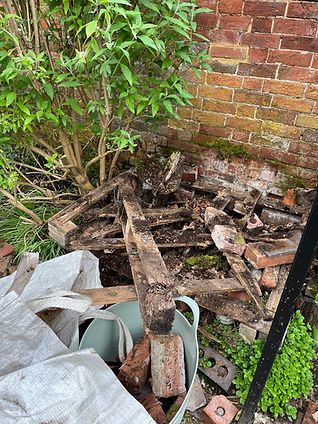

And that was our Saturday at Elford Hall Walled Gardens. Please do come and give us a visit soon, I promise it is much more exciting than I make it sound in these news articles!
This piece was written by Ashley Jones, garden volunteer. If you would like to volunteer at the garden, please get in contact, you would be most welcome!
Update from the garden 8th March 2026
Spring cleaning. Jobs that nobody looks forward to, but are very much needed and my word do they give a sense of satisfaction when they're complete! That is exactly the mixture of feelings that I got this past week as I undertook the annual job of giving the tool shed a good clean and de-cluttering. We are very fortunate to be in a position, where we currently have sufficient quantity of tools for volunteers to use in the garden here at Elford, however over time, and with a sometimes not so meticulous approach to keeping tools clean before they are put away, the tools can become rather raged looking, with signs of rot, rust and wear and tear aplenty. Border forks get put back in the wrong place, handles caked in mud, and items get lost. It only takes a few people to forget to put tools back as they found them and the entire system can come crashing down- hence the annual clear-out. It is only once I took the entire contents of the tool shed out of the bothy building, that it became apparent to me just how many shovels we had, and one was left questioning how many are really necessary! And so, what followed was the throwing away of those which were no longer in working order, trowels with rotten handles, broken prongs to border forks and shears so blunt and rusted that they are beyond restoring, unfortunately there were a few items which went off to the tool graveyard. Next came a good sweep out of the bothy, and a clean of all the tools we would be keeping. The final task of the day was putting everything back into the tool shed, ordered and grouped neatly, ready for action! The tool shed looks quite nice at the present moment, now we just have to wait and see how long we can make it stay that way!

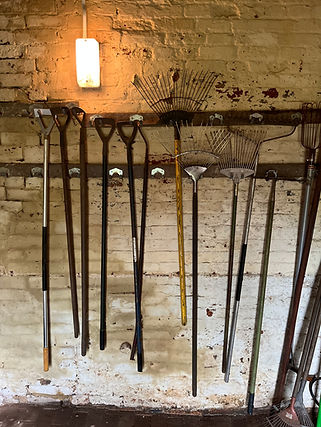

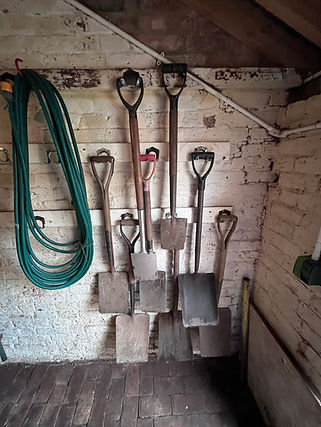
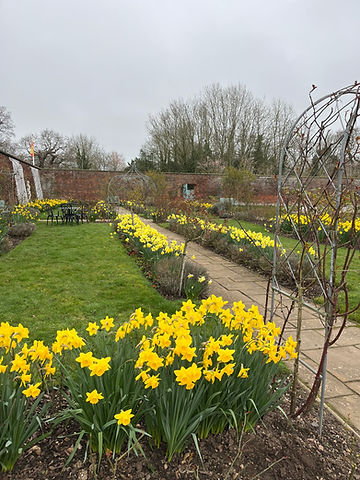
Onto a less dull note, the garden at Elford really is beginning to liven up! Daffs can be found around each corner, with a splash of yellow everywhere you look, which if you are like me and enjoy the blooms of Narcissi, is a true delight! As the weeks tick by, the ground warms up and days lengthen, which means that something new can be seen in the garden on each visit. Just take a look at the long border for instance- last week there were Hellebores in bloom but this week they are joined by drifts of Narcissi and Muscari. If you have time over the coming month, please do come and visit, I promise you won't be disappointed, especially if you visit on a volunteer day (Tuesday, Thursday and Saturday) when you may just be in luck and can enjoy a piece of Sue's lovely homemade cakes (for a donation of course!). They're well worth it- just ask my waistline!
In the orchard the trees are still at the end of their period of dormancy, but it won't be too long now before the scene comes alive with blossom. The orchard is still worth a visit however, as some lovely examples of Primula vulgaris can be seen lying along the back of the walled garden, heading towards the sensory garden.



This piece was written by Ashley Jones, garden volunteer. If you would like to volunteer at the garden, please get in contact, you would be most welcome!
Update from the garden 22nd February 2026
The days are getting longer and finally there was some warmth in the sun over this past weekend. After the what feels like weeks and weeks of rain, a spot of dry weather was a very welcome gift on Saturday and a sense of Spring was most certainly in the air. A quick walk around the garden and I spotted a few treats which lifted my spirits no end. In the Rose garden, whilst the showpiece shrubs and standards will not have their blooms on display for several weeks yet, the back wall is awash with gorgeous Daffodils which bring a smile to my face and I am sure will do the same for many others. Next onto the long border, where you may remember an earlier blog post discussed the work in preparing our Hellebores for flowering (see here). Well now they are indeed in full bloom and look very pretty indeed if I don't say so myself! Opposite the long border, we have some gorgeous Almond trees which are just coming into blossom and if you get close enough (but not so close to disturb) you can hear the buzzing of bees as they search for some early nectar!


This is the perfect time of year to divide Snowdrops and I was hard at work on Saturday morning, digging up and dividing clumps from the back of the wooded area, which isn't visible to guests from the path, and planting the separated bulbs "in the green" in new, suitable locations, around the garden. Some have been planted in drifts, closer to the edge of the path in the wooded area heading towards the pump house, whilst others have been planted in the shaded area of the sensory garden. These should clump up over the coming years and add to our display of Spring flowers.
The hard work to maintain the gardens ramps up as the weather improves. We absolutely love having visitors at the gardens but the grounds need constant maintenance to keep the gardens looking neat and tidy. We would love to welcome more volunteers to help us in achieving this. The site is run entirely by volunteers and we are a charitable project. There is no charge for visitors to the gardens but we very much welcome donations. Tea and biscuits (and ice creams on a warm day) are available in the bothy on volunteer days for a donation. Our volunteers spend their own time and money to provide these items for volunteers so please do be generous where you can be. All money raised goes towards keeping the gardens running.
This piece was written by Ashley Jones, garden volunteer. If you would like to volunteer at the garden, please get in contact, you would be most welcome!

Update from the garden 5th February 2026
Well, it may not feel like it, as I write this news article on a cold, very wet and windy evening, but we are nearly there- I promise that Spring is bounding towards us at speed, and soon we shall have the delights of brighter evenings and our favourite perennial garden plants will begin to emerge from their hibernation.
Saturday the 31st of January was dry and sunny, the perfect winter day for getting outside into the (very) fresh air, alongside my fellow Elford Hall Garden volunteers. Myself and Charlie had a busy day working on the restoration project of our hurdle fencing, which lines the driveway. It is a project which Charlie has been diligently battling through, on and off, for a number of months now (which is discussed in far greater detail in an earlier blog post found below). Rotten fence posts are being replaced with new ones which are still made of the traditional wood, and are being concreted in place at the base in an attempt to prevent them from rotting. It is hard and heavy work, but what satisfaction when the section of fence is completed!
Although it is forecast to be wet throughout most of the coming weekend, if you do get a chance over the next fortnight, I would implore you to come and visit the gardens. We have some beautiful drifts of snowdrops in various corners of the garden, and as the weeks tick by, they will be joined by more and more Spring flowers. Last week I already saw the first Daff in flower, and there are many more just waiting for the right time, dotted along the river bed.
And if you have some little ones with you, why not also visit our wild woods and say hello to Mr Badger?


Images:
The Golden yellow of Winter Aconite flowers, ready to unfurl,
A solitary Daffodil in flower in the Rose Garden,
Snowdrops in full regimental splendour


This piece was written by Ashley Jones, garden volunteer. If you would like to volunteer at the garden, please get in contact, you would be most welcome!
Update from the garden 17th January 2026
What a difference a week makes. From feeling like we were in the depths of winter, to sensing that Spring is just around the corner, this week has felt like a pleasant period of calm after a spell of wintry weather. Snowdrops are out and daffodils are poking their heads up from the ground to see what all this calamity is about! I for one am grateful to see the emergence of these fabulous bulbs and take it as a reminder that there will always be new life and growth after a hard cold winter.


Saturday was a busy but exciting day in the garden volunteering for myself and Darryl. We were given a fascinating and invaluable tutorial on pruning apple trees by our very own volunteer Allan. As I've mentioned before in my Elford Garden News articles, we are very lucky indeed to have Allan as a volunteer here at Elford Hall Garden, and not just because he is a superb character to have around the place, and a real, old school gentleman to-boot! Allan spent his working life in orchards across the South, especially in his home county, the garden of England that is Kent, and is an incredibly skilled, and knowledgeable gardener.
Ever since first reading the fantastic Thomas Hardy novel ‘The Woodlanders’ a few years back, I have been utterly obsessed with the splendour of Britain’s woodlands, especially the traditional orchards which are now sadly becoming increasingly rare as more and more land is swallowed up by monotonous brick housing estates. Elford does not have an ancient orchard, but the garden is home to a beautiful, fairly young orchard which sits outside the walled garden (it is actually nearing 20 years since the orchard was planted). Row upon row of Apple trees stand proud amongst grassy meadow, underplanted with wild Daffodils ( Narcissus pseudonarcissus), cowslip (Primula veris) and the common primrose (Primula vulgaris), whilst a few plum trees and a Damson, can be found on the far western edge. Of the apples there are many varieties of cider apple, numerous eating varieties such as Falstaff, Ambassy and the incredibly tasty russet variety which is Ashmeade’s Kernel, dual purpose varieties such as Blenheim Orange (usable from late September as a cooking apple, and from October to January as an eating apple), and finally pure cookers like Grenadier and the fabulously named Peasgood's Nonsuch, to name but a few.
Allan, who has been looking after our orchard for a number of years now, alongside fellow volunteers such as Dave Watton, was kind enough to give myself and fellow volunteer Darryl, a beginners lesson in how to prune a mature apple tree, after months and months of us badgering him to do so!
I can honestly and sincerely say that it was a genuine joy to see a master at work, as we stood and watched Allan circle the tree, with secateurs and saw to hand, making cuts in various places, to open up the tree into a fabulous shape. There is quite clearly much to consider in order to prune correctly, but Allan made it look incredibly easy, barely even pausing as he made the necessary adjustments to the tree. As he worked, Allan explained in detail how was having to think months ahead whilst doing his work, considering what shape of canopy he wanted to try and create, how the weight of the apples may influence this shape and that as branches would be pulled down as the year progressed with leaves unfurling from buds and fruits swelling. Whilst a branch may appear fine in winter, when it is bare of any leaves or fruits, a heavy crop of fruit will add significant weight that will lower the branch. "We don't want the fruits to be touching the floor for a start", joked Allan, "but we also don't want the branch to bend and rub against any other branches, as that could cause wounds which may be vulnerable to infection and disease. We want to help create a fine shaped tree, a healthy structure for fruit to grow on for many years to come".
Allan then described the importance of ensuring there was good air circulation through the branches of the tree. The aim of our pruning activities would be to create a nice open centre, though which air will flow easily. If you think about how the tree will look in the height of summer, with its leaves on full display and fruit swelling, we would need to ensure air could freely move through that canopy, to prevent any fungal disease from taking hold. Allan continued his work and expressed to me how his old mentors used to say that the aim is to be able to throw your hat clean through the centre of the tree without touching any branches. This meant that any new growth that was heading inwards towards the centre of the tree was to be removed. Sharp and clean tools are a must to prevent causing disease, and just as important is making sure that the cut is clean and made right back to a bud or join- "No coat hangers", Allan joked!
Allan went on to explain that he aimed to create a balance between old wood which had healthy fruit buds, and suitable one and two year growth, which would hopefully soon be smothered in healthy new fruiting buds, in order to keep the tree rejuvenated and in fit condition to keep cropping in abundance!


Allan also explained the process of watershoot management and tip-pruning to me. When a large limb is removed from a tree, because of for example an attempt to cut out canker, the tree will send up lots of vertical shoots which are called watershoots. These are somewhat vigorous growths which don't bare any fruiting buds for the first two years. Because they all shoot from around the old cut of a significant limb, they can cause overcrowding. Most are removed but Allan says that he tends to leave one or two to draw the growth and stop excessive growth elsewhere in the tree. Allan then explained the process of tip pruning. The watershoot is vertical, but we want to create side branching out and away from the centre of the tree in order to allow the fruit to hang nicely along the branch, at an angle which allows the fruit to get some sun and airflow. Making a cut just above a healthy wood bud (a bud carrying leaves but no flowers which are noticeably smaller than a fruit bud) should encourage a side shoot and more horizontal growth.
There was a lot to take in and Allan will be letting me loose on a chosen apple tree in the orchard next week so that I can try and put his teaching to good use. Therefore if you see an oddly pruned tree in the coming weeks on your visit, you'll know that I'm to blame!
It was however a thoroughly enjoyable day and I was incredibly grateful to Allan for giving up his time and going back to basics with me. This is for me, a great example of the superb benefits that comes with being a volunteer at Elford Hall Garden. Not only do you get to enjoy the benefits of being in the outdoors, making a contribution to a worthy project, but you also make close friendships with fellow volunteers and get to learn from their invaluable experience and knowledge. To be able to learn this horticultural skill from someone with a lifetimes experience is an opportunity that I would struggle to get elsewhere, and it would certainly cost a significant amount! Perhaps Allan should start charging me for his time!
As always, we are eager to welcome new volunteers, and if this sounds like the sort of activity you'd enjoy, then please do come down and visit us at the garden (or check out the volunteer page above).
This piece was written by Ashley Jones, garden volunteer. If you would like to volunteer at the garden, please get in contact, you would be most welcome!
Update from the garden 11th January 2026
A Happy New Year to all our friends and visitors! The new year began with cold weather as we welcomed snow to Elford in the week commencing 5th January 2026 and a storm on Friday afternoon brought further windy and snowy gusts. Needless to say there was not much we could do on the first Saturday volunteer session of the year, except enjoy the snowy scenery.
As there is little to share this week from the volunteers, I will instead take the opportunity to share some news about an upcoming event here at Elford. On Saturday 28th February, Burton Phoenix Canoe Club will be hosting a race down the River Tame, starting from Elford Garden and heading up to Burton! It was a spectacular site last year and so we hope to see you on the 28th February this year too!


This piece was written by Ashley Jones, garden volunteer. If you would like to volunteer at the garden, please get in contact, you would be most welcome!
Update from the garden 21st December 2025
Saturday the 20th December brought the final Volunteer Saturday of 2025. Whilst we were all left scratching our heads, asking where the year had gone, we were able to gather in the bothy for a celebratory tea break. It was brilliant to welcome back some of the volunteers who we've not been able to see for a short while, which meant the bothy was bustling with activity. Homemade sausage rolls, a variety of cake, homemade biscuits, Pork Pie and Mince Pies were all thoroughly enjoyed. We also enjoyed a small sample of the fruity gin which Sue, Allan and Alison had prepared for us, having collected a variety of fruits earlier in the year and infused into gin over recent months. There was Damson Gin from Alison, Gooseberry gin from Allan (which was my favourite as it had a lovely taste that was not overly sweet but still incredibly fresh and warming- a true taste of summer!) and Bullace gin from Sue. All the fruits had been collected from trees and shrubs here at the Elford garden. A quick sample certainly put us all in a festive spirit (although I promise we were all very responsible and only had a very small sample to taste!)


It wasn't all festivities in the Bothy however, and we all tried to make the most of this final Saturday volunteering session of the year. Flooding restricted us somewhat but a wide variety of jobs were underway around the garden. Allan began the annual Apple tree pruning with help from Lynne, Esther and Co. John continued his hard work painting the buildings around the site, this time in the Head Gardener's Cottage, Mary our stalwart volunteer, was busy caring for the Rose garden as always. Alan and his son were making sure the allotment plot is all set for the New Year, and Daryl, Gordon and myself were busy cleaning up the borders, as well as ensuring our old grey Fergie and it's trailer were covered up and protected for winter.

I also continued my work in the herbaceous border. It has been a slow but rewarding job to tackle the ground elder in the herbaceous border, but I'm slowly getting there and hope to rejuvenate the space in the new year now that we have (hopefully) lessened the weed's stranglehold on the area.
Ground elder (Aegopodium podagraria) which is also known by the common names "bishop's weed", or "Jack-jump-about", is quite a troublesome foe for a gardener. It spreads quickly across the floor from a carpet of shallow roots, which are actually rhizomes. The rhizomatous root system enables this colonisation, acting as food source to provide an abundance of energy stores to help the plant spread and colonise new areas of soil. The plant does have benefits for wildlife (numerous beetles, leaf miners, butterflies and moths feed on ground elder) and in late spring it produces a beautiful umbel of white flowers, similar to cow parsley, but it can be a bully and we have taken the decision to try and control it's spread through the herbaceous border, to allow other plants to thrive in the space.
It is believed that ground elder was introduced into Britain by the Romans, who valued the medicinal and edible uses of the plant. It has a tangy, parsley like flavour with leaves able to be picked whilst young as an addition to salads. Gout is one of the ailments that ground elder has been used to treat in the not too distant past.
The underground stems (rhizomes) allow the plant to regenerate quickly and spread. This is an adaptation that the plant has developed over thousands of years to enable it to survive and colonise new areas of land. However, this adaptation means that it can be quite a task to remove the weed. If the rhizomes are severed during the process of removal (digging) then new plants can regenerate from small sections of rhizome left in the soil. This means you cannot just pull the crown of the plant to remove it, nor can you use a rotavator (which I would advise against in any case due to the disruption it would cause to the soil structure, fungi and micro-organisms). Removing all of the plant, roots and all, is the only organic way to remove the weed. For me this meant forking out the plants and roots, sieving in order to make sure I'm not just removing tonnes of soil, and then adding the weed to the pile to be burnt (we don't want to add the roots to the compost). It is immensely rewarding to be able to step back and see where we have been working in the herbaceous border and hopefully come the Spring, we will be able to see that our efforts have at least slowed down the spread of the plant.

This piece was written by Ashley Jones, garden volunteer. If you would like to volunteer at the garden, please get in contact, you would be most welcome!
Update from the garden 14th December 2025
Here at Elford the volunteers have been getting into the festive spirit with full gusto. The annual Christmas lunch for volunteers did not disappoint. For a second year in a row we congregated at the fantastic local establishment 'The Crown Elford'. With a warm fire keeping us cosy, delicious food, fantastic company and a drink for the non-drivers, the afternoon was very much enjoyed by all. It is always nice to get together and see the friendly faces of our fellow volunteers. Many stories of the past year were shared and I myself felt incredibly reluctant to brave the cold of the outdoors after such a lovely few hours in such a nice country pub setting. Of course the Christmas meal is one of many social occasions we get to look forwards to as volunteers, so if you are interested in joining in next year, please do take a look at our volunteers page- We very much welcome new faces to the volunteer group!


One of our creative volunteers, Jenny, has superbly crafted a fab piece of needlework to represent Elford Garden on the patch-work runner, which is being created to cover the 13m long "Table For The Nation" at Lichfield Cathedral, which was visited by His Majesty The King in recent weeks. We are very proud to be represented in this piece of community artwork, thank you Jenny!

The project is linked to the Fenland Black Oak Project. During routine cultivations in 2012 on a farm in south-west Norfolk, a 13.2 metre section of a huge ancient oak was unearthed. This "jubilee oak" was transformed into full length table for the nation. It is a fascinating story and well worth a visit to Lichfield Cathedral, where the table will be on display until May 2026.
This piece was written by Ashley Jones, garden volunteer. If you would like to volunteer at the garden, please get in contact, you would be most welcome!
Update from the garden 30th November 2025
We are now less than four weeks away from Christmas day and here at Elford Hall Garden we are just excited as everybody else. The bothy has been decorated by the volunteers and it is certainly a cosy place to stop, take a minute or two for yourself and enjoy a nice cup of tea or coffee, a biscuit or maybe even a piece of cake. Sprigs of holly adorn the windowsill, mistletoe is draped above the doorway, the Christmas tree awaits the visit of you know who, a visit to our garden will certainly get you in the Christmas spirit!

The crab apple in the sensory garden is adorned with crimson fruits, which in the low evening sun catches the light fabulously, in a way which is reminiscent of Christmas baubles reflecting the firelight on a dark winters night. Just around the corner there is more colour to draw the eye. The lush green foliage and dappled yellow flowers of Mahonia x media 'Winter Sun' is superb, whilst the delicate white flowers and pink buds of Viburnum farreri really 'pop' out from bare, arching stems. It just goes to show, if you look hard enough there is still plenty to get excited about in the garden, even at this time of year.


There were still jobs a plenty on a wet and windy Saturday. Mary was once again busy in the Rose Garden, John has begun painting the walls inside the open barn opposite the orchard walk, Gordon battled the elements and cleared surface water from the paths of the sensory garden. We are working hard to tidy up the herbaceous border and on Saturday I did some cutting back of the hellebores. Hellebore leaf spot is a fungal disease which can easily infect leaves and stems of our winter favourite plant, giving rise to ugly, dead brown spots. It most often occurs in winter and so November is the perfect time of year to conduct some maintenance. Cutting off the previous season's foliage, right to the base, prevents the disease from infecting flowers, which will soon emerge. Below is a before and after image. It is important to remember to collect the removed foliage so that there is no chance of the fungal spores spreading amongst the plants which remain.


This piece was written by Ashley Jones, garden volunteer. If you would like to volunteer at the garden, please get in contact, you would be most welcome!
Update from the garden 16th November 2025
Well we wanted rain and this past week we certainly got it! Storm Claudia brought gusty winds and buckets full of rain to Elford on Friday night, meaning the Saturday volunteers had a busy time clearing up and making the gardens look presentable once again. Visitors will know that we are very lucky indeed to be situated directly on the banks of the River Tame, which makes for a tranquil and peaceful setting all year round. However, we of course need to be aware that the river comes with its own natural rhythms of the seasons. So wet weather can bring a little bit of flooding, more often so in recent years. On Saturday morning the river burst its banks and rose up into the Boat house, as tends to happen a few times a year these days. In addition to this, our compost bins soon became an island surrounded by rising water. Clean up operations here will have to wait a couple of days, at least until the river drops back to usual levels! Unfortunately the downpour also left the ground in our car park somewhat saturated and so we have had to close the field parking in order to protect the ground (and to prevent our visitors from becoming stranded in mud!).


It wasn't all doom and gloom however! As I entered the garden to open up, I realised I was sharing the morning bird song with an inquisitive little pheasant, who was inspecting the brassicas of Alan's allotment! Thankfully Alan is an incredibly tidy and well organised gardener, and so his butterfly cage netting protected his leafy veg from the visiting wildlife! I was also so very pleased to see the return of much loved volunteer Gordon, who has been greatly missed in recent weeks after illness. We are all glad to see you back Gordon!

A busy morning was spent raking up leaves, sweeping paths, getting the log burner going in the bothy, and finally clearing gutters of leaves and debris. A few blockages cleared in the downpipes and wire balls (to prevent future issues) installed, and it was another job ticked off the to-do list! 11:00am brought a timely and well deserved tea break. Sue looks after us volunteers incredibly well and my first mince pie of the season went down beautifully with a warm cup of tea in front of the fire! Who wouldn't want to be a volunteer with perks like these!


There are so many jobs to be done and so little time to manage it all. We'd certainly be lost without our superb volunteers. Mary had a busy day weeding the Rose Garden, which she maintains so diligently and beautifully, alongside fellow volunteer Julie. John was engrossed in clearing path edges of weeds, whilst Alan and Allan were busy attending their respective allotment plots. Sue cleaned the facilities within the bothy and gardener's cottage, as well as putting out her homemade marmalade on the produce table (feel free to come and purchase some at the garden- it's delicious on a nice thick piece of toast!), whilst Dave was busy working away in the barn. Gordon cleared brambles and nettles which were encroaching onto the path entering the sensory garden from the orchard walk. For myself and Daryl, the rest of the day was spent cutting back in the herbaceous border, where a lot of foliage had been badly impacted by the heavy wind and rain of recent days. Coming weeks will see us battling Ground Elder in the border, which became more noticeable as we cut back some of the herbaceous perennials. The Ground Elder will need to come out, roots and all, to prevent it from suffocating the surrounding plants.

Finally, if you have visited our garden in the past few weeks, you may have also seen our latest installation. Sadly one of the Oaks in the border had succumb to rot and a major split developed. The result of this being that cutting back was a necessity. Thankfully we've managed to make the best out of an unfortunate situation. The parts of the tree which were not impacted by rot were left in situ and have been superbly carved into a Grasshopper! We hope you like him!

This piece was written by Ashley Jones, garden volunteer. If you would like to volunteer at the garden, please get in contact, you would be most welcome!
Autumn 2025- The Elford Garden Newsletter



Update from the garden 26th October 2025
On your last visit to Elford Hall Garden, did you notice our rustic fencing? Along the entrance driveway here at Elford, we use a rustic hurdle style of fence. We try to use natural materials in keeping with the beautiful setting here at the walled garden. Unfortunately the extreme weather of recent years has taken its toll on our poor fencing, with rot taking hold of many of the fence posts. Our aim is to maintain the garden as best we can and so this has meant a significant project is being undertaken to repair the fencing.

Throughout the past weeks, our volunteer twins Charlie and Harry, alongside Darryl and Dave, have been working hard to restore the fencing. This past Saturday saw efforts continue, with a traditional method of charring the fence posts being employed to help weatherproof the wood. This method adopts a Japanese method of charring wood, known as Yakisugi. This involves preserving the wood by partially charring the surface (without burning the entire piece of wood) to simply seal the surface with a water-resistant layer. An added benefit is that the wood is protected from insects, fungi and mould.
The first step was to remove the outer bark layer of the wood, using a traditional draw knife, as is pictured below

Once the wood is prepared by scraping away the bark, the surface is ready to be lightly charred. A hot bonfire did the trick for us, and helped keep the cold October winds at bay! Rotating the wood to get an even charring, without causing the centre of the wood to combust, required care and attention.


The final results were impressive, if we don't say so ourselves! A good morning's work for the volunteers, some new skills obtained and hopefully some weatherproof fencing! We hope you like what we have done, feel free to come and take a look the next time you visit!
This piece was written by Ashley Jones, garden volunteer. If you would like to volunteer at the garden, please get in contact, you would be most welcome!

Update from the garden 8th October 2025
The curtains have closed on summer for another year, but there is still plenty to see out in the garden at this time of year. At Elford Hall Garden a wide array of colours can be seen as we are being treated to a veritable feast for the eyes through changing colours of leaf canopy, late blooms of flowers and luscious fruits. Ivy is coming into flower, with umbels of an incredible hue of yellow-green. Ivy gets bad press because of its ability to act like a sail on old, weakened trees, as well as the aerial roots which can damage the structures they cling to. Having said this, Ivy plays a vital role in the natural world and is an incredibly valuable food source for pollinating insects such as bees, as well as being safe shelter for small song birds. Here at Elford we have Ivy winding its way around the old Oak tree by the river bank, as well as ivy along the hedgerow by the compost bins.


In addition to the ivy, there are some late flowering perennials which provide some lovely warming colour to the garden. At this time of the year I am particularly fond of the sunflower Helianthus 'Lemon Queen', which can be found by the bothy, as well as the range of Michaelmas daisies, such as the one pictured below which sits around the back of the head gardener's cottage.


As well as flora to seek out, the allotments are still producing bountiful harvest. Alan, an allotment holder here at Elford, and his son, who are also valued volunteers, have regularly produced an abundance of crops. This year the squashes have been superb.


This piece was written by Ashley Jones, garden volunteer. If you would like to volunteer at the garden, please get in contact, you would be most welcome!
Update from the garden 1st October 2025
It's so hard for me to pick a favourite time of the year at Elford Hall Garden. As the new year begins the garden brings me peace and solace, the first snowdrops of late January/early February, bring warmth to the heart when cold, bitter winds are howling all around. Spring is special. Swathes of daffodil down by the river bank, or in the Rose Garden, brighten the mood. As we hit May there is a vibrancy in the green of the natural surroundings that can't be witnessed at any other time of year. I think that May is perhaps the time when the garden is looking its very best. The excitement of fresh blooms, an array of colour and the promise of the summer to come can not be challenged, means that the garden is the place to be! All that being said, for me Autumn at Elford Hall Garden is the most spectacular time of year. We are very lucky to have a thriving orchard at Elford Hall Garden, and as October comes there is a particular atmosphere in the air- it's time for the apple harvest!
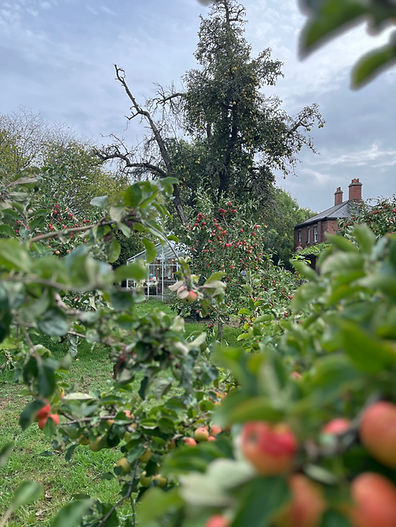

We have a wide number of varieties here in the orchard. A selection of cider apples, cookers and eating apples. Some of which I have photographed below. There were many more varieties which were picked by volunteers and made available for visitors to take away, which I did not manage to get a picture of! This included old favourites, such as the incredibly flavoured russet apple Ashmeade's Kernel.


The orchard is well into its teenage years now and the harvests we have been receiving have been really superb in recent years. We are extremely grateful that long-time volunteer Allan, has a wealth of experience in working amongst orchards far and wide. Through his careful guidance and Dave's care and attention, the orchard is kept in top shape all year round. As we reach September, myself and my fellow volunteer Darryl, look forwards to the Saturday mornings where Dave will tell us which trees are ripe for picking. We pick trees clean of the fruit, discarding any rotten or bruised fruits into the hedgerow for birds and insects to feed from. Windfall apples are inspected and any which are good enough to use for cider are collected. Those of an eating or cooking variety are plucked from the trees and set aside for visitors to take away from the produce table. The cider varieties are picked clean and then they go to be washed, pulped and pressed by the volunteers on a Tuesday morning. The deliciously zingy juices are collected and set aside for a period to ferment and mature, before being bottled up and become available for purchase from the barn.


This piece was written by Ashley Jones, garden volunteer. If you would like to volunteer at the garden, please get in contact, you would be most welcome!
Update from the garden 6th September 2025
This year's harvest just keeps on giving!
We've had another busy week at Elford with volunteers working away to keep the garden looking superb, as well as harvesting all the delicious fresh fruit which our amazing plants have produced this year.
We are now in early autumn and there is plenty of interest in our garden for visitors to come and take a look at. The trees are turning and we are beginning to see some lovely colours in the leaves. There are also autumn flowering Cyclamen hederifolium down by the river (my favourite spot!), waking up from their dormant period. Crab apples are providing some warm colours to the hedgerow and will be a key source of food for our wildlife in the months ahead.
Our sensory garden is beginning to turn as herbaceous perennials start to die back and hunker down for winter, but there are still bursts of colour, such as the tottering purple blooms of Verbena bonariensis!
A good selection of cider apples have been picked by the Saturday volunteers and are ready for pulping and pressing in the week ahead.
Again we have an abundance of plums, damsons and eating apples available to purchase from the produce table. I can personally vouch that they are absolutely delicious, so please do come down to the garden and have a nose around! Eat them fresh, make a plum jam or a damson crumble- whatever takes your fancy!
This piece was written by Ashley Jones, garden volunteer. If you would like to volunteer at the garden, please get in contact, you would be most welcome!


Update from the garden 1st September 2025
What a summer it has been! Warm and very dry, this year has been a treat but also a real challenge for the natural world, including our garden. As autumn approaches we will be working on harvesting fruit from our wonderful orchard. In the last few weeks volunteers have been picking plums which are available to purchase from our produce table. They're very good this year!
We'll be picking apples in the coming weeks; eaters, cooking and of course a variety for our home pressed cider, available to purchase from the barn.
Meanwhile on the produce table opposite the head gardener's cottage, you will find a selection of homemade preserves, freshly picked fruit and veg, and a selection of plants, available for purchase.
All money raised goes towards keeping the garden running. So why not head down to the garden and check out what produce we have on offer!
This piece was written by Ashley Jones, garden volunteer. If you would like to volunteer at the garden, please get in contact, you would be most welcome!


Garden volunteer Darryl picking plums in the orchard
Victoria plums freshly picked
Update from the garden 9th May 2025
Well, what a fabulous Spring we have had. Warm with plenty of sunshine, this Spring has brought an abundance of early colour. As I enter the Elford site I am instantly enveloped by a lush, vibrant green which radiates energy and life. Birds are calling from the hedgerow and there is a distant hum of life coming from the numerous pollinating insects we are lucky to share our site with.
Head down through the walled garden, and on the South facing wall, hidden behind the Apple cordons, you will find our Wisteria, which is currently in full show. A waterfall of white petals cover the entire wall, it is incredibly peaceful to simply stand and stare, to take in the natural elegance of Spring.
Moving on to the Sensory garden and you can see bursts of colour in every corner. I am particularly taken by the bearded iris this year!
Down by the river, which is such a peaceful spot on a calm Spring morning, the river bank is awash with Cow parsley and is well worth a visit.
This past week has also seen Elford celebrate VE Day. We've welcomed so many generous visitors recently and we are so very grateful for all the kind donations which is vital to keeping the gardens running. There were a number of attractions at the garden for the celebration, from an afternoon tea party, to live music and even a teddy bear zip line. We hope all our visitors had a memorable visit and please do come back again soon!
This piece was written by Ashley Jones, garden volunteer. If you would like to volunteer at the garden, please get in contact, you would be most welcome!


Winter 2024-2025


